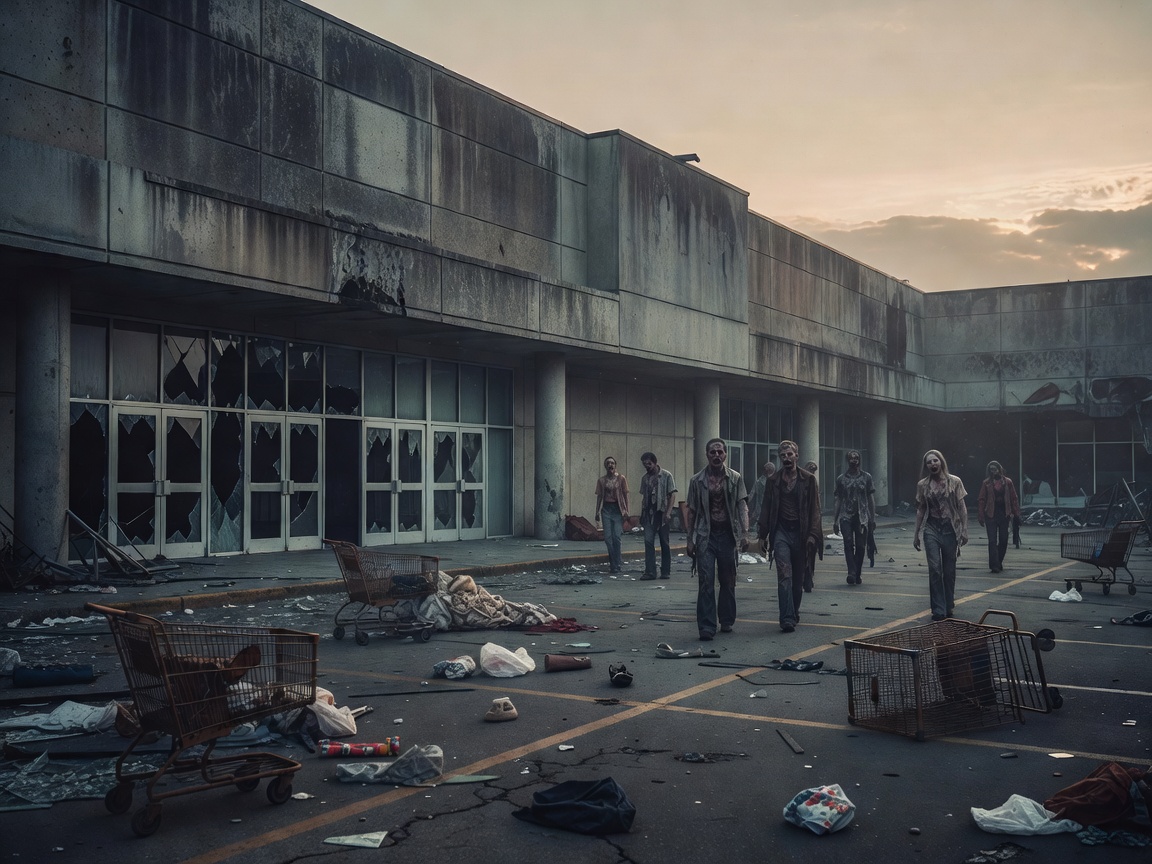
Situation report
The outbreak is now weeks old and society is visibly collapsing. In a chaotic Philadelphia television studio, staff argue on air while the broadcast falls apart. Traffic reporter Stephen and his partner Francine decide to flee in the station's helicopter. They are joined by Peter and Roger, two SWAT officers shaken by a brutal raid on a tenement building where residents had been hiding their dead.
The group lands on the roof of a vast suburban shopping mall; the film was shot at the Monroeville Mall outside Pittsburgh. Room by room, they turn it into a private fortress. With lorries parked across the entrances and the dead cleared from inside, they have food, clothes, guns, televisions and even an ice rink. What they gradually lose is purpose. When a marauding biker gang spots the mall, the survivors learn that possessions are only worth what you can defend.
Why this film still matters
Dawn is the moment zombie cinema became openly satirical. The dead drift back to the mall out of what Stephen describes as instinct and memory, because it was an important place in their lives. The joke lands on the living just as hard: once the survivors own everything, they become bored, quarrelsome and oddly lonely.
It also raised the bar for effects. Tom Savini's makeup work, from the grey-blue skin of the dead to vivid head wounds, became a benchmark for practical gore. Romero released the film unrated in the United States rather than accept an X rating, a gamble that paid off.
The production was an international partnership. Italian filmmaker Dario Argento helped finance the film and supervised a European cut, released as Zombi, that is shorter and leans more heavily on the music of Italian band Goblin. The film's success in Italy encouraged a wave of Italian zombie pictures, including Lucio Fulci's Zombi 2, which was marketed there as an unofficial follow-up.
Survival lessons from the mall
- Pick a base with supplies and chokepoints. The mall works because it combines resources with doors that can be blocked.
- Secure the entrances before anything else. The lorry operation is the most dangerous sequence in the film, and it costs the group dearly.
- Skill gaps matter. Peter and Roger are trained; Stephen is not. The difference shows every time weapons come out.
- Complacency is a threat. Once comfortable, the group stops planning. Boredom and ego do more damage than the dead.
- Keep your exit fuelled. The helicopter is their lifeline, and its fuel level matters right up to the last shot.
Pros and cons for today's viewer
Pros
- Sharp, still-relevant satire of consumer culture.
- Landmark practical effects by Tom Savini.
- Strong central cast, especially Ken Foree as Peter.
- A genuinely tense final act.
Cons
- Over two hours in most cuts, with slow patches.
- Bright, paint-like blood looks dated.
- Slapstick moments undercut the horror for some.
- Multiple versions can confuse first-time viewers.
How it compares
| Film | Undead speed | Stronghold | Main theme |
|---|---|---|---|
| Night of the Living Dead | Slow | Farmhouse | Distrust between survivors |
| Dawn of the Dead | Slow | Shopping mall | Consumerism, complacency |
| World War Z | Swarming | Walled cities, ships | Global response |
Which cut to watch
There are three main versions. The US theatrical cut, about 127 minutes, is Romero's preferred balance of horror and satire and the best starting point. Argento's European cut is shorter and faster, with more of Goblin's score. A longer extended version, often called the Cannes cut, adds character scenes that fans enjoy on a repeat viewing.
Zack Snyder's 2004 remake, written by James Gunn and starring Sarah Polley and Ving Rhames, keeps the mall but switches to fast-moving undead. It's a leaner action-horror film, and comparing the two shows exactly how much speed changes the genre.