Situation report
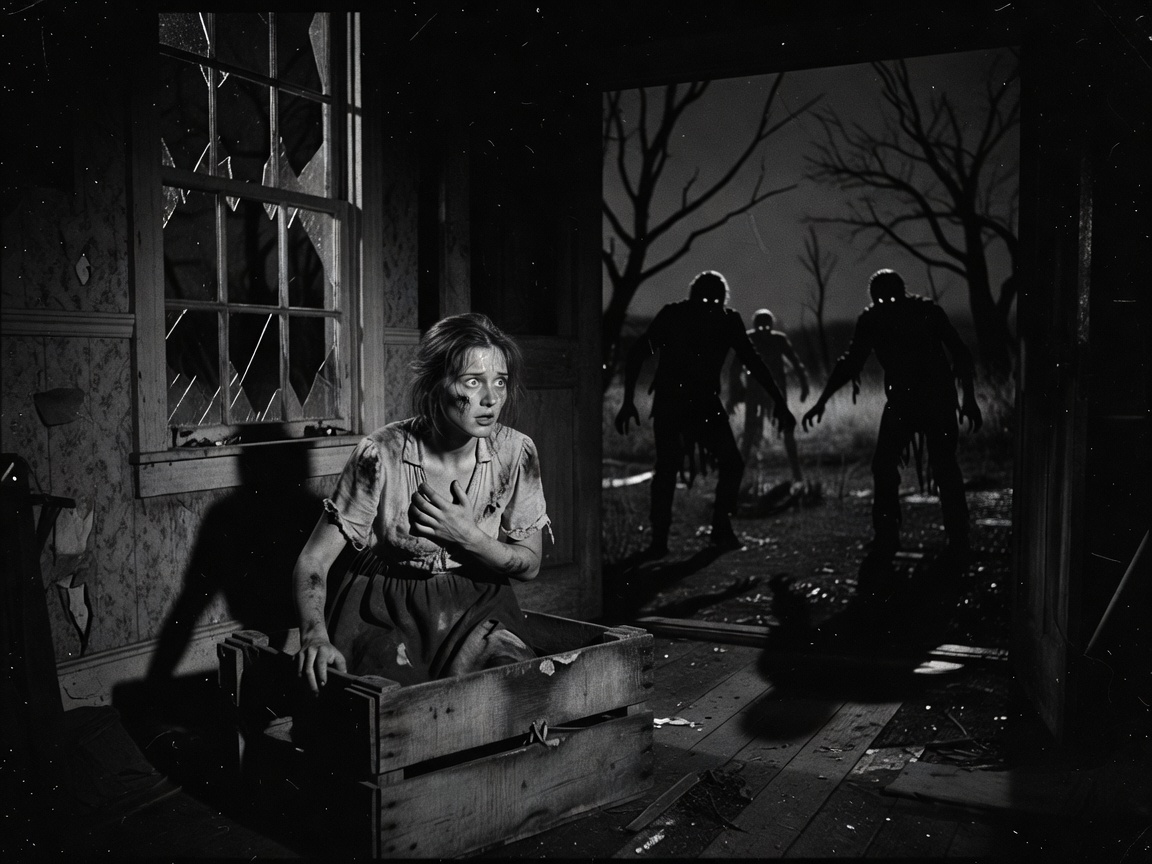
Night of the Living Dead opens on an ordinary errand. Siblings Barbra and Johnny drive to a rural Pennsylvania cemetery to lay a wreath on their father's grave, bickering the way siblings do. Within minutes a lurching stranger attacks, Johnny is knocked down, and Barbra flees to an isolated farmhouse. There she meets Ben, a calm, practical drifter who starts boarding up windows while radio and television bulletins try to explain why the recently dead are rising and attacking the living.
Hidden in the cellar are the Cooper family, Harry, Helen and their injured daughter Karen, along with a young couple, Tom and Judy. The rest of the film is a pressure cooker: seven people, one house, too many doors, and a basic disagreement about whether the cellar is a refuge or a tomb. News reports float a returning space probe and its radiation as a possible cause, but the film never confirms it, and that uncertainty is part of the fear.
Why this film still matters
Before 1968, screen zombies were mostly the voodoo variety: entranced labourers controlled by a master. Romero and co-writer John A. Russo took inspiration from the siege structure of Richard Matheson's novel I Am Legend and produced something new: a mindless, hungry crowd of the recently dead. The film calls them "ghouls," yet nearly every rule audiences now associate with zombies traces back here.
- The dead rise en masse, with no master and no purpose beyond hunger.
- Destroying the brain, or burning the body, stops them.
- The dead and the fatally wounded come back, as the Cooper storyline brutally shows.
- The most dangerous thing in the house is often another survivor.
Casting mattered too. Duane Jones, a Black actor, plays Ben as the most competent person in the house, which was unusual for an American film of 1968. Romero said Jones simply gave the best audition, but the final minutes, in which an armed posse sweeps the countryside, land very differently because of who Ben is and the year the film came out.
A distribution quirk extended its reach. The original release prints lacked a proper copyright notice, which left the film in the public domain in the United States. It turned up on countless late-night broadcasts and budget home video releases for decades, and generations of future filmmakers saw it as a result.
Survival lessons from the farmhouse
- Fortify, but never seal your only exit. Ben's boarding buys time, but once the escape plan fails the house becomes a trap.
- Information is a resource. The group clusters around the TV for news of rescue stations. Knowing where help is decides who moves and when.
- Fire works, and fire backfires. Torches hold the ghouls back, but the rushed refuelling run shows how a panicked plan involving petrol ends in disaster.
- Settle leadership early. The Ben-versus-Harry argument over the cellar burns the hours when cooperation mattered most.
Pros and cons for today's viewer
Pros
- Lean runtime of about 96 minutes.
- Grainy monochrome photography gives it a documentary edge.
- An ending that still hits hard.
- Essential context for every other film on this list.
Cons
- Uneven performances in some supporting roles.
- Talky stretches in the middle act.
- Very modest effects by modern standards.
- Barbra's near-catatonic state frustrates some viewers.
How it compares
| Film | Undead speed | Setting | Tone |
|---|---|---|---|
| Night of the Living Dead | Slow | Single farmhouse | Bleak, claustrophobic |
| Dawn of the Dead | Slow | Shopping mall | Satirical, gory |
| 28 Days Later | Fast | Empty Britain | Raw, urgent |
Which version to watch
Because the film is in the US public domain, quality varies enormously between releases. Look for a restored black-and-white presentation; The Criterion Collection issued a 4K restoration in 2018 that many fans treat as the reference version. Be aware that colourised editions exist, as does a 1999 "30th Anniversary Edition" that added newly shot scenes and a new score. Most viewers regard that one as a curiosity rather than the real film.
Tom Savini, Romero's longtime makeup effects collaborator, directed a 1990 remake that gives Barbra a much tougher role. It makes an interesting double bill once you have seen the original.