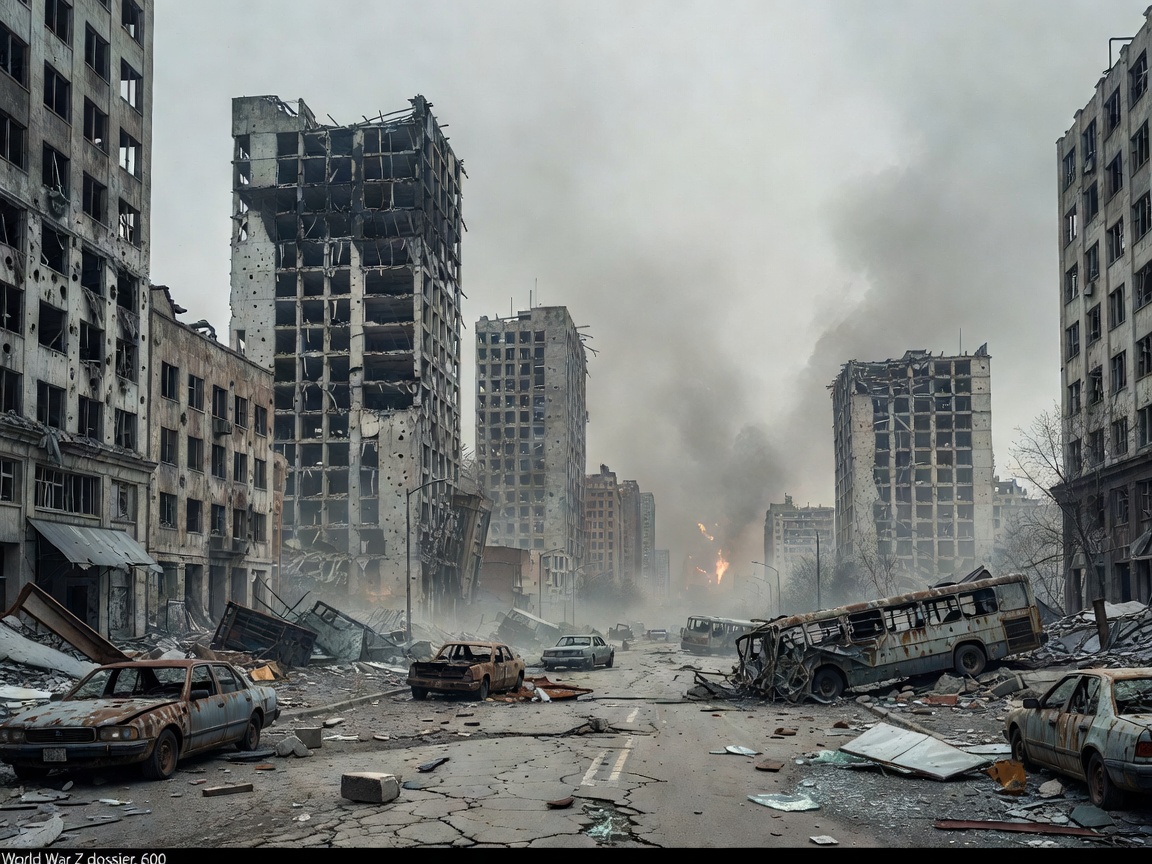
Situation report
Gerry Lane, a former United Nations investigator played by Brad Pitt, is stuck in city traffic with his wife Karin (Mireille Enos) and their two daughters when the outbreak explodes around them. The Philadelphia scenes were actually filmed in Glasgow, dressed to look American. After a frantic escape through Newark, the family is airlifted to a US Navy ship, where Gerry is given a stark choice: help find the source of the pandemic, or his family loses its place on board.
His search takes him to a US base in South Korea, then to Jerusalem, where a massive wall has kept the dead out until a noisy crowd draws them over it in a human pyramid. With Israeli soldier Segen (Daniella Kertesz) he escapes on a commercial flight that is soon overrun, and the survivors crash-land in Wales, near a World Health Organization research facility in Cardiff. Here, in quiet corridors full of infected staff, Gerry tests a theory: the dead appear to ignore people who are already seriously ill.
Why this film still matters
World War Z took the zombie film to the scale of a disaster movie. Its infected turn within seconds of a bite and move like a flood, pouring through streets and piling over walls. Those swarming sequences, especially in Jerusalem, became the film's signature image and influenced how later productions staged hordes.
It became one of the highest-grossing zombie films ever released, and its PG-13 rating was a deliberate choice: the horror comes from scale and tension rather than gore, which opened the genre to a broad family audience.
Behind the scenes, the production was famously difficult. The original ending, a large battle in Russia, was scrapped, and writers including Damon Lindelof and Drew Goddard reworked the third act. The reshot finale at the WHO lab is smaller and more suspenseful, and many viewers consider it the strongest part of the film. Peter Capaldi, shortly before his time on Doctor Who, appears as one of the WHO doctors.
How it differs from the book
The film shares its title with Max Brooks's 2006 novel, World War Z: An Oral History of the Zombie War, but little else. The book is told as a collection of interviews after the war, with slow zombies and a focus on politics, logistics and memory. The film keeps the global perspective and a few ideas, such as Israel's early wall, but reinvents almost everything else as a single-hero thriller. Read the book as a separate experience rather than a companion.
Survival lessons from the swarm
- Noise discipline saves lives. In Jerusalem, amplified singing draws the horde over the wall. In Cardiff, a single can of soda nearly gives Gerry away.
- Keep moving. Gerry survives by relocating constantly. Staying in one place, however fortified, lets the swarm find you.
- Observe before you act. The breakthrough comes from noticing which people the infected pass over. Careful observation beats firepower.
- Count the seconds. Gerry times how long a bite takes to turn someone, and uses it to decide whether he's been infected.
- Walls are not enough. A barrier helps, but only with the discipline to use it properly.
Pros and cons for today's viewer
Pros
- Spectacular large-scale horde sequences.
- A tense, well-crafted final act.
- Accessible for viewers who avoid heavy gore.
- Fast-moving, globe-trotting structure.
Cons
- Very loose adaptation of the novel.
- Supporting characters are thinly drawn.
- Digital swarms can look weightless.
- Less bite for horror fans who want blood.
How it compares
| Film | Scale | Gore level | Key tactic |
|---|---|---|---|
| Dawn of the Dead | One building | High | Fortify a base |
| Train to Busan | One train | Moderate | Use darkness |
| World War Z | Global | Low | Silence and camouflage |
Viewing tips
An extended, unrated cut exists alongside the theatrical version, with slightly more violence. Either works, though the theatrical cut is tighter. A sequel was announced and later shelved, so this remains a self-contained story.